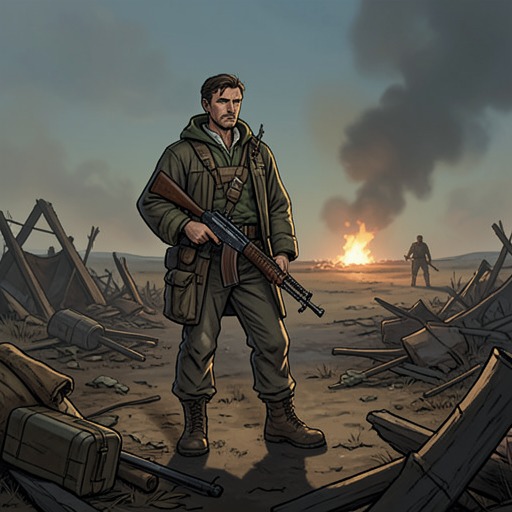
Savage 99
The Dog StarsThe Savage 99 is Hig’s .308 lever-action rifle and the central firearm in his ambush of approaching attackers. Initially treated by Bangley as an old-fashioned choice, it becomes a practical advantage: its side-loading magazine lets Hig reload by thumb, while its familiar operation allows him to fire and cycle the action rapidly. The rifle links preparation to action, carrying Bangley’s tactical instruction into a moment when Hig must rely on practiced movements rather than deliberation.
Identity and Design
Bangley identifies Hig’s weapon as a Savage 99 and recognizes that its side-loading magazine can be worked more quickly than a rifle that must be turned over for loading. His first response is dismissive of the lever-action design, which he regards as a nostalgic choice; that judgment changes when he understands how this particular rifle can be reloaded. The exchange establishes a distinction between the model’s old-fashioned appearance and its practical utility in Hig’s circumstances.
The rifle is chambered for .308 ammunition. Its lever action requires a deliberate cycle between shots, but the side loading gives Hig a direct way to feed cartridges into the magazine. Bangley explains that, if there is time, the lever can also be worked slowly and quietly to feed another cartridge. The weapon’s value therefore depends not on being effortless or modern, but on Hig knowing how to use its specific mechanism and being able to keep ammunition within reach.
Preparation for the Ambush
As Hig moves the sled and conceals it in sage, he takes the rifle and a box of shells from the equipment carried there. He lays the rifle across the hide-covered hindquarter of a deer. Because the animal had been quartered with its hide left on, the fur provides a firm support for the barrel. A choice made earlier to preserve the meat during transport thus also gives Hig a stable rest at the moment he needs one.
Hig arranges the rifle and ammunition so that he can load without changing the cartridges’ direction. Before the attackers reach the trail, he lays out thirteen brass shells in a row, chambers one, and places another in the magazine, leaving twelve in reserve. He thinks of the thirteen as lucky and as two full reloads. The arrangement makes the rifle part of a larger, deliberate setup: the firearm is supported, the cartridges are ordered, and the next movements are prepared in advance.
This preparation follows Bangley’s instructions. Bangley has advised Hig to keep ammunition close, rather than all in his hand, and to lay it out where it can be reached from the sled. His guidance is specific to the Savage 99: Hig can thumb cartridges into the side magazine and use the lever to load another when circumstances allow. The difference between a general supply of ammunition and a usable sequence of rounds is made concrete in the way Hig positions each object before taking aim.
Use in the Attack
When the first attackers appear at the trail, Hig sights with the rifle resting on the deer hide. The men come into view in succession, carrying weapons of their own; more follow behind them. Hig fires at the first three, cycling the lever and shifting his aim between shots, then fires again toward two men together. The narration records four attackers struck in the initial volley of action. It presents the sequence as a practiced chain of aiming, firing, levering, and redirecting the rifle rather than as a series of newly considered choices.
The side-loading design is especially relevant to what Bangley has taught him: Hig has ammunition laid out and the means to reload without turning the rifle over. The account does not pause to show a reload during these first shots, but the preparation gives the firing sequence its material basis. The Savage 99 is not merely present at the ambush; it is integrated into Hig’s position, supported by the hide, supplied with rounds, and used through movements familiar from earlier hunting.
Narrative Significance
The rifle’s significance lies in the meeting of familiarity and changed purpose. Hig has used the same lever-action pattern while hunting deer, and during the ambush he draws on that experience to move the barrel across targets. The familiar action does not make the confrontation ordinary: the men approaching him are attackers, and the rifle now serves defense. Yet the mechanics of the weapon offer a structure for action when thought gives way to immediate response.
Bangley’s initial mockery also gives the Savage 99 a small reversal in the scene. What seems to him an outdated choice has a side-loading feature he considers faster than turning the rifle over, and his recognition changes the tone of his instruction. Hig’s weapon remains a lever-action .308, not a newly acquired or transformed object; what changes is the scene’s understanding of its usefulness. In the ambush, the rifle becomes the point where Hig’s hunting skill, Bangley’s tactical coaching, and careful preparation converge.